
What's Important in an AI Content Writer for SEO?

To get results from an AI content writer for SEO, you must choose software that captures your firsthand experience instead of copying search results. Search engines and AI answer engines do not need another summary of existing web pages. They look for new facts, real opinions, and practical details from people who actually do the work.
I own and built Articulator, a software platform made to capture human experience and turn it into search-ready articles. Because of that, I have a direct commercial stake in this topic. As someone who has worked in SEO for 30 years with clients across the globe, I built Articulator to solve the exact data-scraping problem that broke my early AI publishing tests.
Many software tools promise high rankings with one click. In practice, they rely on recycled text and fake quality scores. You need a setup that helps you share what you know, measures your content against real search rules, and gets your work found online.
What is an AI Content Writer for SEO in Practice
Most people think of automated writing as a way to generate words quickly. When you write to rank on search engines, the goal is much more specific. An AI content writer creates content for a user that should be optimized to rank well in search engines. It should satisfy the search algorithms used by search engines such as Google to enable the generated content to appear high up in SERP (search engine ranking position) when a person searches for a query related to that article's target keyword.
Search algorithms are the computer programs search engines use to sort through billions of web pages. Their job is to find the most helpful answers for a searcher. When someone types a question into a search bar, the engine scans its index. It looks for content that answers the question clearly, shows real proof, and comes from a trustworthy source.
Writing for search engine ranking positions requires more than just sprinkling a keyword across a few paragraphs. A basic writing assistant simply predicts the next likely word in a sentence. It does not know whether a fact is true, whether an idea is original, or whether a page satisfies what the reader wanted to find. An SEO-focused writer must shape the draft so it lines up with how search crawlers evaluate quality. If the software merely fills a blank page with generic text, it fails at the basic job of search engine optimization.

Why Most AI Articles Fail to Rank in Search Results
When generative text tools first became popular, many web publishers tried to flood the internet with automated pages. I tested that approach myself to see how search engines would handle it. I used multiple AI writers such as ChatGPT, Gemini, and QuillBot in the early days of AI article generation, but the articles rarely appeared in search results. Because they were just scraping existing data, search engine algorithms decided there was nothing new to see here, so the content wasn't even indexed and therefore would never appear in search results. In other words, it was a complete waste of time and probably did the websites where the articles were published more harm than good.
Indexing is the first hurdle in search engine optimization. Before your article can compete for a ranking position, Google has to store it in its database. When a search crawler visits your site, it spends computing power to read your page. If the crawler sees that your article simply rephrases ten other articles already in its database, it drops your page. The engine saves its resources for fresh information.
Publishing hundreds of pages that never get indexed burns your site budget. Worse, search engines notice when a site hosts large piles of low-value, recycled text. The algorithms can flag the entire domain as low quality. When that happens, even your good, handwritten pages lose their rankings. The rush to create cheap articles often ends with lost search traffic that takes months of hard cleanup work to fix.
How Scraping Differs From Firsthand Practitioner Experience
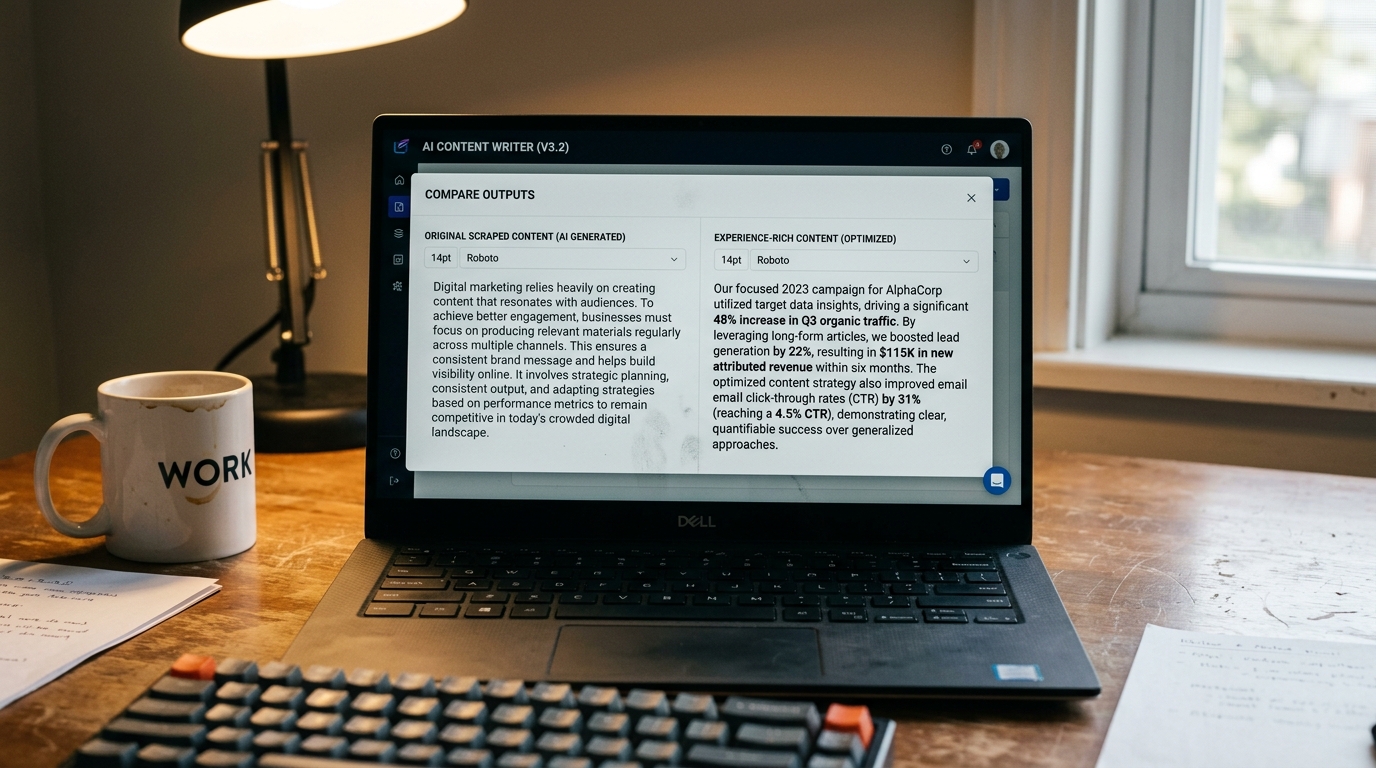
The fundamental flaw of generic tools is where they get their source material. They scrape existing web pages, rearrange the sentences, and present the result as a fresh draft. An AI article writer can churn out an article in mere seconds, but that doesn't mean it will be a good quality article that satisfies algorithms for SEO.
A handwritten and well-researched article can take days, but provided it has some unique data or insights, it will perform much better due to Information Gain provided by the user. AI article writers can't write from experience, nor can they add any new information that doesn't already exist on the internet. This is why we designed Articulator as a hybrid AI article writer. It blends the user's real experience and ideas and uses AI to help create a high-quality blog article that satisfies the algorithms for SEO.
Search engines have public patents and systems built around a concept called Information Gain. When a reader clicks through three different search results, they do not want to read the exact same advice three times. If your article gives the reader a new data point, a fresh angle, or a practical warning they could not find elsewhere, the search engine scores your page higher.
| Content Feature | Scraped AI Content | Experience-Driven Content |
|---|---|---|
| Source Data | Public web pages and search engine snippets | Firsthand human work, tests, and observations |
| Production Speed | Under 30 seconds per draft | 20 minutes with guided input |
| Index Rate | Very low due to duplicate concepts | High because the page introduces fresh details |
| Information Gain | Zero new facts added to the web | High value from unique tests and real outcomes |
| Search Engine Risk | High risk of quality flags and indexing drops | Low risk because it offers real reader value |
An unassisted computer program cannot test a physical product, run a business workflow, or speak with an upset customer. It only knows what people wrote on the internet in the past. When an SEO tool relies only on scraping, it traps you in a cycle of copying your competitors. Real performance comes from extracting what you already know from your daily work and placing those raw facts into the draft.
Building an SEO Article with Articulator in Twenty Minutes
Writing everything by hand takes days of deep research, drafting, and editing. Most business owners and marketing teams simply do not have that kind of time. When I started building articles with Articulator—which uses my own experience combined with AI—I could write an article in just 20 minutes that had a considerably high chance of ranking well in search engine results or being picked up by LLMs.
The first article I wrote was about different types of tennis balls that I had personal experience playing with. Articulator successfully wrote about my own experience because, in the article planning stage, it interviewed me and asked me relevant questions. It then put the experience that I had given it into the draft article.
The software did not guess how the tennis balls performed on a cold morning or how fast the felt wore out on a hard court. It asked me directly, collected my exact thoughts, and structured those observations into clear sections. The draft had details that no scraper could find because those details came straight out of my own tennis sessions.
After generating the text, the draft went straight into a structured review. The first draft is then reviewed in an audit process where Articulator guided me on certain elements of the article that I could improve. There are multiple metrics that it scores to help me assess the quality of my article. It looks at important things such as information gain and E-E-A-T, which stands for experience, expertise, authority, and trust—a key metric used by Google. When I'm happy with my revisions, I am able to publish the finished article quickly.
Instead of staring at a blank page for hours or letting a bot write generic fluff, the workflow keeps you in the editor role. You supply the raw experience, the software shapes the structure, and the audit highlights any weak spots before you push the article live.
Evaluating Scoring Integrity Across Six Core Metrics
Most content tools include an on-page score to tell you if your article is ready to publish. Often people rely on the AI writer's own SEO score and trust that it's accurate. However, very often that score is used more as a marketing tool than a real metric guided by the important algorithms which determine whether content is cited by LLMs or ranked by Google. Articulator's scoring methods are based around the important algorithms rather than trying to fool users into thinking they have just generated the perfect article every time. Because we all know that's not possible.
A tool that gives every draft a 95 out of 100 just to make you feel good does not help your business. Real search systems look at several separate factors when grading a page. A dependable evaluation framework must measure six specific areas:
- Overall EEAT Score: Measures whether the article shows genuine experience, deep subject expertise, authoritative backing, and trustworthy facts. Search engines look for clear signs that a real practitioner wrote or shaped the advice.
- LLM Citation Score: Checks how easily large language models can pull out clear facts and cite your page in AI-powered search answers. Clear entity names and direct answers boost this rating.
- Information Gain Score: Tracks whether the article contains original insights, numbers, or perspectives missing from the current top search results. Without this, your page looks like an unneeded duplicate.
- Reader Value Score: Evaluates how directly the text solves the searcher's problem without burying the answer under filler paragraphs.
- SEO Rating: Reviews technical on-page essentials, including heading structure, keyword relevance, clear title tags, and natural topic coverage.
- User Experience Rating: Scans for readability, clear paragraph lengths, simple language, and clean formatting that keeps human visitors on the page.
If an AI writing tool hides these details behind a single happy score, be careful. You need to see where your draft is weak so you can fix it before search engine crawlers find it.
How to Choose the Right AI Content Writer for Your Workflow
Selecting software for your content workflow comes down to how the platform handles source information and grades quality. If you pick a tool that merely scrapes the web and hands you back a polished summary, you will run into the same indexing walls I faced during my early tests.
Before you buy an AI writing tool, review it against these practical questions:
- Does the software interview you or extract your personal knowledge before it generates a draft?
- Can you easily add custom figures: client examples, and physical test results into the article builder?
- Does the platform score drafts across separate metrics like Information Gain and EEAT, or does it give you a single inflated vanity score?
- Are the audit suggestions focused on algorithmic search standards rather than just keyword density?
- Does the output sound like an active professional explaining a real process: or does it use empty marketing filler?
If a tool cannot capture your firsthand knowledge, skip it. Search engines and AI engines have plenty of basic text to read. They need your specific experience, and the right tool should make getting that experience onto the page simple and fast.
FAQ
What should I prepare before using an experience-based AI writer?
Have your rough notes, test numbers, customer examples, or key opinions ready. The software needs your real observations during the planning step so it can build an article with genuine information gain.
Will search engines penalize content just because AI helped write it?
Search engines penalize low-quality, scraped content that adds nothing new to the web. They reward helpful pages that provide real value, accurate answers, and firsthand experience, regardless of which software assisted the writer.