How to Rank Articulator Content Beyond On-Page SEO

Ranking Articulator written content in competitive search environments means winning top placement on Google search results while earning regular citations from language models answering technical queries. Basic keyword placement alone will not get you there. For a lean website with solid information, search crawlers can index and surface new work in under a few weeks, sometimes in just a few days.
Generating an articulate draft is only the initial hurdle. If your site architecture is blocked, your crawl budget is squandered on thousands of auto-generated pages, or your promotional strategy consists of dropping bare links with generic text on Hacker News, Discord communities, or developer channels, search crawlers and AI models will ignore your work. Pushing past surface-level search engine optimization demands pairing Information Gain with an active technical validation and distribution routine. That's why Articulator interviews you, helping it to draw out real human points of view, expertise and experience. Articulator helps to ensure that AI written articles are good enough to publish. But it's only part of the process.
What Ranking Articulator Content Actually Means Beyond On-page SEO
AI answer engines use vector retrieval—converting text into mathematical concepts—to select source passages that supply verified metrics and clear operational findings. Simply placing a keyword in the H1 bypasses those node selection criteria and ignores half the modern discovery ecosystem.
This visibility drives commercial outcomes on transactional queries such as industry roundups, buyer's guides, and product comparisons. When a buyer asks an AI engine or Google for an informed product recommendation, the algorithm looks for pages that show genuine domain expertise. If your article serves as that foundational source, the engine steers users directly toward the specific products you evaluated.
Why Basic Optimization Falls Short Without Technical Validation
Clean writing cannot rescue an unindexable site. Google allocates finite crawl budgets to scanning your domain. If your site is weighed down with thousands of thin, generic AI pages, Googlebot exhausts its budget and leaves before discovering your latest work. On an established domain that publishes original research twice a week, Googlebot typically visits every day.
Use Google Search Console to confirm search engines can actually parse your pages. If server responses drag or elements shift during rendering, the Page Experience report flags the failure immediately. Unrendered scripts block indexation just as effectively as a broken server.
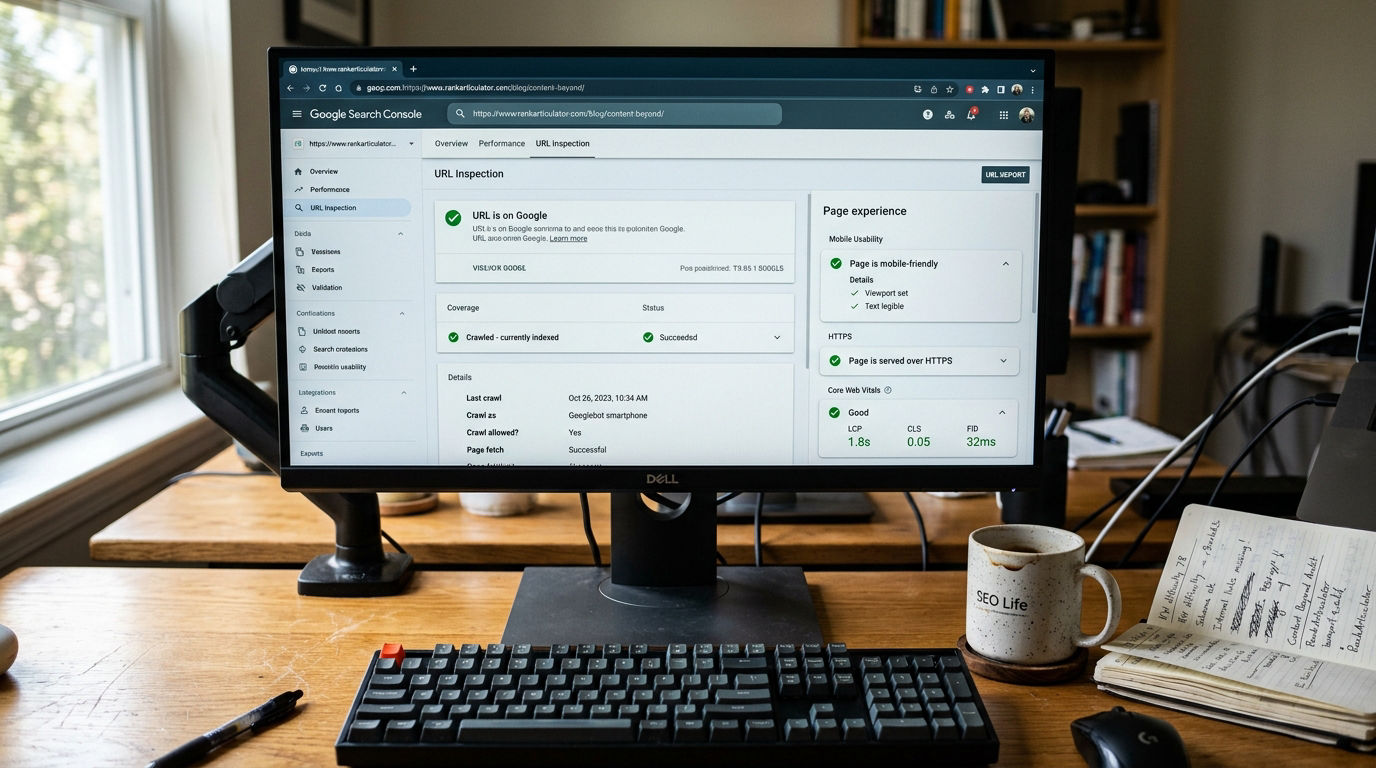
If your setup fails these fundamental checks, search bots deprioritize your content. A consistent technical audit catches these roadblocks:
- Robots access: Confirm your robots.txt file does not inadvertently block search user agents from scanning your core content directories.
- Rendering speed: Review the Page Experience section in Google Search Console to fix Core Web Vitals issues, focusing on cumulative layout shifts and interaction delays.
- Index status: Monitor the Pages report to verify that new articles transition from discovered to indexed instead of stalling in crawl queues.
- Sitemap hygiene: Submit dynamic XML sitemaps that refresh automatically when articles publish, making sure broken URLs are purged quickly.
The Mechanics of Information Gain and Original Research
Ticking the technically correct on-page boxes only sets a baseline. Outperforming competing articles requires conducting your own research and bringing your own quality data to the table. If you simply pull background from existing top-ranking web pages without contributing fresh facts, even with Articulator you are merely reorganizing information that already exists online. Search engines and LLMs recognize that derivative loop and classify the page as low-value filler.
Inside Articulator, this standard is quantified through Information Gain during the brief and questions stage. The metric measures how much net-new data, first-hand insight, and original experience you add to an article compared to existing web documents covering the topic. If an article lacks enough new data or original insight, search engines and AI models will routinely ignore it even if you satisfy every other technical requirement. You have to conduct thorough research before structuring your article, layering your own experience-based opinions and insider industry tips directly into the draft.
I started writing content for websites in 2003 working for an e-commerce company selling water sports goods. We wrote honest reviews of gear we carried, comparing individual products against alternatives. Because we only stocked gear we genuinely liked and used ourselves, our reviews were extremely biased, yet they were written honestly with solid information and real experience gained from using the gear on the water. That practical feedback earned number-one rankings on Google and drove direct sales. Today, whether reviewing physical gear or auditing software workflows, grounding your text in reproducible stress tests provides the verifiable data points that search engines and language models use to evaluate authority.
When outlining an article, integrate distinct operational findings that scraping tools cannot replicate:
"I started writing content for websites in 2003 working for an e-commerce company selling water sports goods."
— Darren Burns - Founder & SEO
- Original test numbers: Embed your own measurements, performance benchmarks, and workflow completion times directly into the text.
- Contrarian observations: Point out where mainstream industry advice fails under real operating conditions, explaining the breakdown with concrete examples.
- Documented failure conditions: Record the exact break points where a tool, software package, or physical component failed under stress, including error codes and environmental limits.
- Attributed source references: Cite independent studies or technical documentation to anchor your original conclusions to verifiable facts.
Passing topical equity across your own catalog is just as essential as citing third-party sources. When you build internal links using descriptive anchor text, you clarify structural relationships for search crawlers. Skip empty anchor text like "click here" or "read more". Use specific phrases that describe the topic waiting on the destination page.
Matching Distribution Channels to Technical Workflows
The most common distribution blunder site owners make is treating social platforms and newsletters like link dumps. Dropping an article link onto Hacker News, Discord communities, or newsletters with generic captions like "read my article" virtually guarantees your post will fail to reach the right audience. Social feeds and newsletter platforms prioritize contextual depth. When an update lacks meaningful context, the platform cannot match it to professionals interested in the subject.
When distributing content across Hacker News, Substack notes, Discord communities, or relevant developer forums, write dedicated summaries that address the technical challenge directly. Put the summary first. If you detail the operational issue you resolved, outline your core findings, and explain the primary takeaway directly in the post feed, readers who interact with that informative summary are significantly more likely to click through to your site, sending qualified engagement signals to your domain.
Those social signals also feed your broader authority pipeline. When industry colleagues discover substantive breakdowns across professional networks, they reference your findings in their own newsletters, discussion forums, and roundup posts. Earning those external editorial backlinks builds domain authority, converting a single published piece into a durable driver of organic traffic.
A Practical Checklist for Pushing Past Basic Optimization
Sustained search visibility requires balancing technical audits, content differentiation, and deliberate external distribution. Start in Google Search Console by pruning thin automated pages to clear crawl budget queues, before you confirm rendering stability in the Page Experience report. Next, eliminate derivative summaries by running pre-draft tests that produce your own numbers and contrarian findings.
Connect these assets internally by pointing high-authority parent guides to new teardowns with descriptive anchor text. Externally, send those original datasets to technical publications to secure earned editorial links. When sharing across Hacker News, Substack, or developer Discords, publish the core finding directly inside the post feed so the community engages with the insight before following the URL.
The Wider Technical and Distribution Workflow Verdict
Writing a strong article inside Articulator is only the initial sprint in a continuous publishing loop. Distribute your content on as many channels as possible. Treat technical validation as a regular routine: check Google Search Console for crawl stalls every Tuesday, audit internal anchor text across new clusters monthly, and publish research breakdowns directly to professional feeds alongside every release. These are important things for SEO and that disciplined cycle turns individual articles into enduring, citable search assets.