Why Articulator Writer Beats All AIs for Google and LLM Visibility

When evaluating how writing tools stack up against foundational language models, content creators quickly run into a wall of generic outputs. Publishing content that ranks and earns citations has fundamentally changed under recent search algorithm updates. Feed a standard language model a generic prompt and you get homogenized consensus text that lacks any original point of view.
Evaluating an AI writing workflow comes down to three factors: how well it extracts primary operator knowledge, the manual editing required to achieve natural prose, and whether it handles structural publishing metadata automatically. A standard generative tool spits out a draft in two to three minutes. Weaving genuine subject-matter expertise into that draft takes another thirty to forty minutes of tedious manual editing. When you factor in the technical mechanics required for real web performance, including schema markup and structural data, standard models fall short.
Where Standard AI Generators Fall Short on Genuine Experience
Search engines and answer engines prioritize original insights over rehashed web summaries. The most important thing for me is that the writing tool is extracting real information and real points of view from the writer. Standard LLMs and most of the AI article generation tools out there don't do this, which is a major flaw because it's a key criteria for getting cited in LLMs or for Google to rank your content as useful under its algorithmic updates. Early adoption taught me this lesson the hard way. Early adoption taught me this lesson the hard way. They vanished from index pages.
When an algorithm crawls a new piece of content, it looks for unique signals that differentiate the page from the top twenty results already indexed. Foundational models are trained to predict the most probable sequence of words based on what already exists on the public web, which mathematically biases them toward median consensus. If you rely entirely on an unassisted model, you end up with predictable lists, repetitive sentence transitions, and an utter lack of operational friction. Real expertise includes messy specifics like an exact invoice amount, a failed product test, an awkward technical workaround, or a contrarian stance on an established workflow. Generic engines filter out those specifics because they do not exist within general training weights.
Comparing Workflow Time, Editing Friction, and Cost
Time is very valuable for people, especially when they are running businesses or have a busy job. Standard AI tools require far too much manual patching once published output undergoes strict editorial review.
Creating a manual article and then weaving your own points of view into that article can take quite a long time to do well. You can, of course, just add a few paragraphs in to try to tick the boxes. But these tend to stick out badly because they don't suit the style of writing of the rest of the article, and the whole thing becomes very easy to detect as AI.
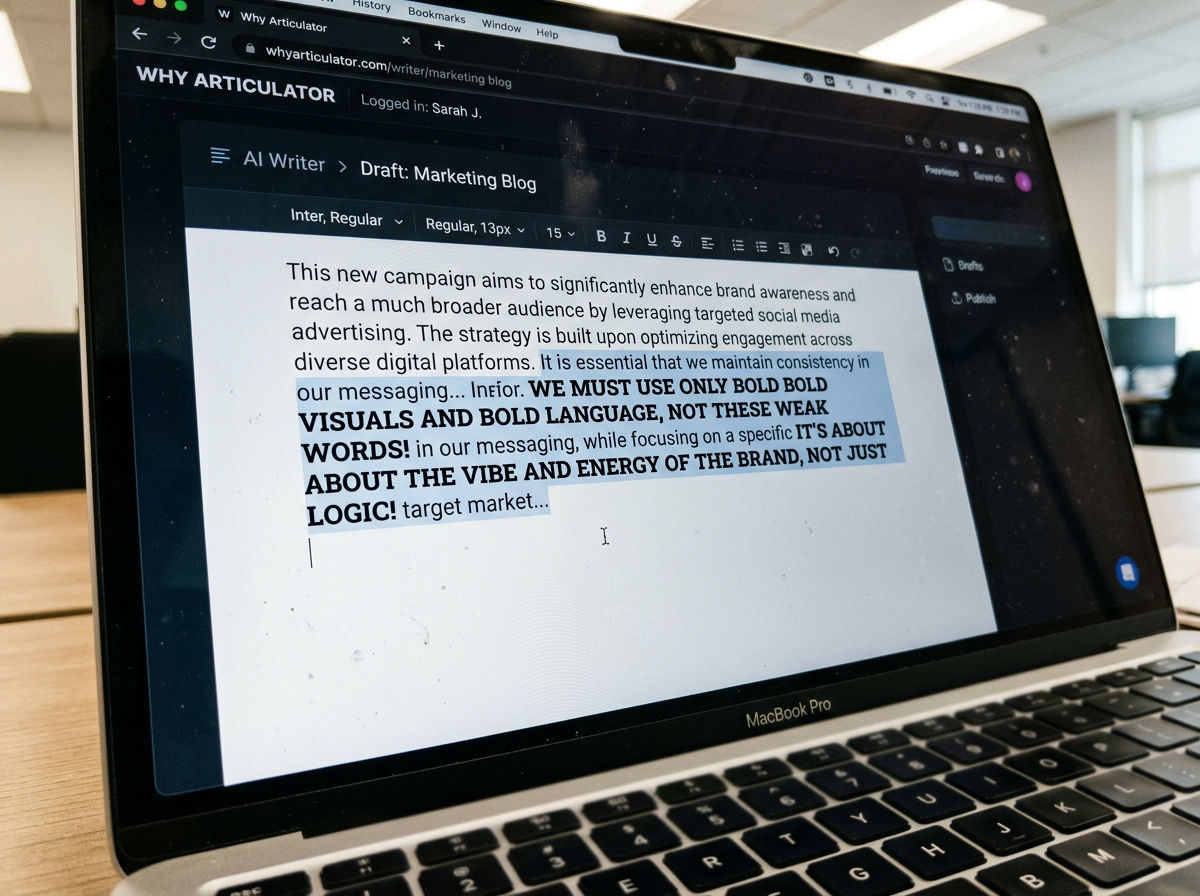
I prefer a tool that weaves my information gain into the entire article in a natural way. This is going to be much harder to detect as AI, and it is going to be a much better experience for the user who is reading it. All of those things help me rank higher on Google and get picked up by LLMs. Speed means nothing if the draft needs total reconstruction.
In terms of cost, the operational math is straightforward once you factor in human labor:
- Generation speed: A standard AI tool drafts an article in 2 to 3 minutes.
- Manual voice editing: Blending real operator experience into generic output takes up to 30 or 40 minutes.
- Dedicated production: Articulator produces a finished, high-quality article in under 15 minutes.
- Direct savings: At an hourly rate of $30, cutting out manual rewriting saves roughly $10 to $15 per article.
Even after spending forty minutes patching a standard AI draft, the prose rarely flows as a cohesive piece. The patched sections read like awkward disclaimers dropped between generic paragraphs. A dedicated engine that captures your voice upfront produces a unified draft that does not require structural surgery before going live.
The Illusion of Inflated SEO and LLM Citation Scores
Many content teams rely on real-time optimization widgets to tell them whether an article is ready to publish. Most of those green dials provide a false sense of security.
I see tools skew their own diagnostics constantly to retain users. Here is how I view that common scoring trap:
"Very often if you use an AI writing tool it will give you an SEO score or an llm citation score and these are heavily heavily skewed towards the article generation tool itself so they often inflate these scores so that you think it's good content and you keep using it and I think this is dishonest because it fools people into thinking they've got good content when a lot of the time they don't it's another reason that I like using articulator.online because it's honest and it's reviews and it actually tells me if it's generated something which isn't perfect and how to fix it."
Fake scores protect retention, not rankings. An optimization dashboard might give a piece of content a rating of 95 out of 100 simply because it hit a series of keyword counts and heading densities. Yet the text itself can be completely devoid of original analysis, containing nothing that would compel an answer engine to cite it as a reference source.
A diagnostic check that flags structural flaws, missing context, or weak assertions allows you to fix the underlying content before publishing. Relying on an algorithm that automatically gives its own generated prose a passing grade guarantees you push unrefined drafts to your live site.
Articulator AI Writer Against Direct Prompting and Dedicated Generators
Before looking at individual publishing mechanics, here is how the primary writing tools and generators compare across pricing, strengths, and operational limitations:
| Product | Price | Best use case | Standout feature | Trade-off |
|---|---|---|---|---|
| Articulator AI writer | $12-39/mo | Expertise-driven content and SEO publishing | Extracts real-world information gain and handles one-click publishing with automated schema | Requires authentic operator input to generate high-value output |
| ChatGPT | Free / ~$20/mo | General-purpose drafting and brainstorming | Flexible foundational LLM prompting | Leaves out underlying structural metadata and requires heavy manual editing |
| Claude | Free / ~$20/mo | Long-form text and nuanced drafting | Strong conversational and synthesis capabilities | Fails out-of-the-gate SEO scoring without manual intervention |
| Gemini | Free / ~$20/mo | General text generation | Broad context window and search integration | Produces generic output that sticks out as AI-generated |
| Byword | Per-article or subscription pricing | Bulk programmatic article generation | Automated generation at scale | Relies on standard AI patterns that lack genuine operator perspective |
| Surfer SEO | Tiered monthly subscriptions (~$89+/mo) | Content optimization and SERP analysis | Detailed content score tracking and keyword guidelines | High SEO Scores are inaccurate marketing ploys. No information gain. |
There are a lot of tools that get compared against Articulator, starting with dedicated generators like Byword and Surfer SEO, right alongside foundational LLMs like Claude, ChatGPT, or Gemini that users prompt directly for SEO-oriented articles. But across my own publishing workflow, when I paste raw output from those tools into Articulator, they simply don't score as well out of the gate. Raw output fails fast.
Byword handles raw volume well, but it relies on automated generation patterns that lack an authentic operator perspective. Surfer SEO provides granular keyword targets, but its content editor is tethered to internal scoring metrics that do not fix generic phrasing. Unassisted foundational models like Claude produce nuanced phrasing and ChatGPT offers broad conversational flexibility, but both leave you with bare text documents that require heavy formatting. Gemini offers search connectivity, but the output still carries standard generative patterns.
Beyond the writing itself, Articulator handles one-click publishing straight to WordPress or Shopify, automatically injecting all the underlying structural data and metadata that standard LLMs leave out. That covers everything from FAQ schema and JSON-LD data to alt tags and background schema markup, saving me roughly 40 to 50 minutes of tedious manual formatting per post.
Choosing the Right Tool for Editorial Publishing
For editorial sites and trade blogs that rely on genuine domain authority to rank, I recommend Articulator every time. It produces honest output that gives me confidence in the underlying structure and data, even though it requires upfront operator input rather than acting as a zero-touch button. If you want a programmatic campaign for thousands of generic landing pages, use Byword instead, and stick to ChatGPT or Claude for general brainstorming. The upfront friction pays off.
Making the switch starts with auditing your current drafting workflow. Track how many minutes your team spends manually patching generic drafts, and verify whether your live posts contain genuine operational details like exact figures or real workarounds. Moving away from multi-tool patchwork to a platform that embeds schema and metadata directly during drafting saves hours while producing content built to rank.
I would clearly recommend Articulator every time. It's the best output that I've seen, it's honest, and that one-click publishing gives me confidence that I'm publishing a well-structured article with all the correct data behind the article.
FAQ
New question?
Your answer.